
Appearance
Inbound
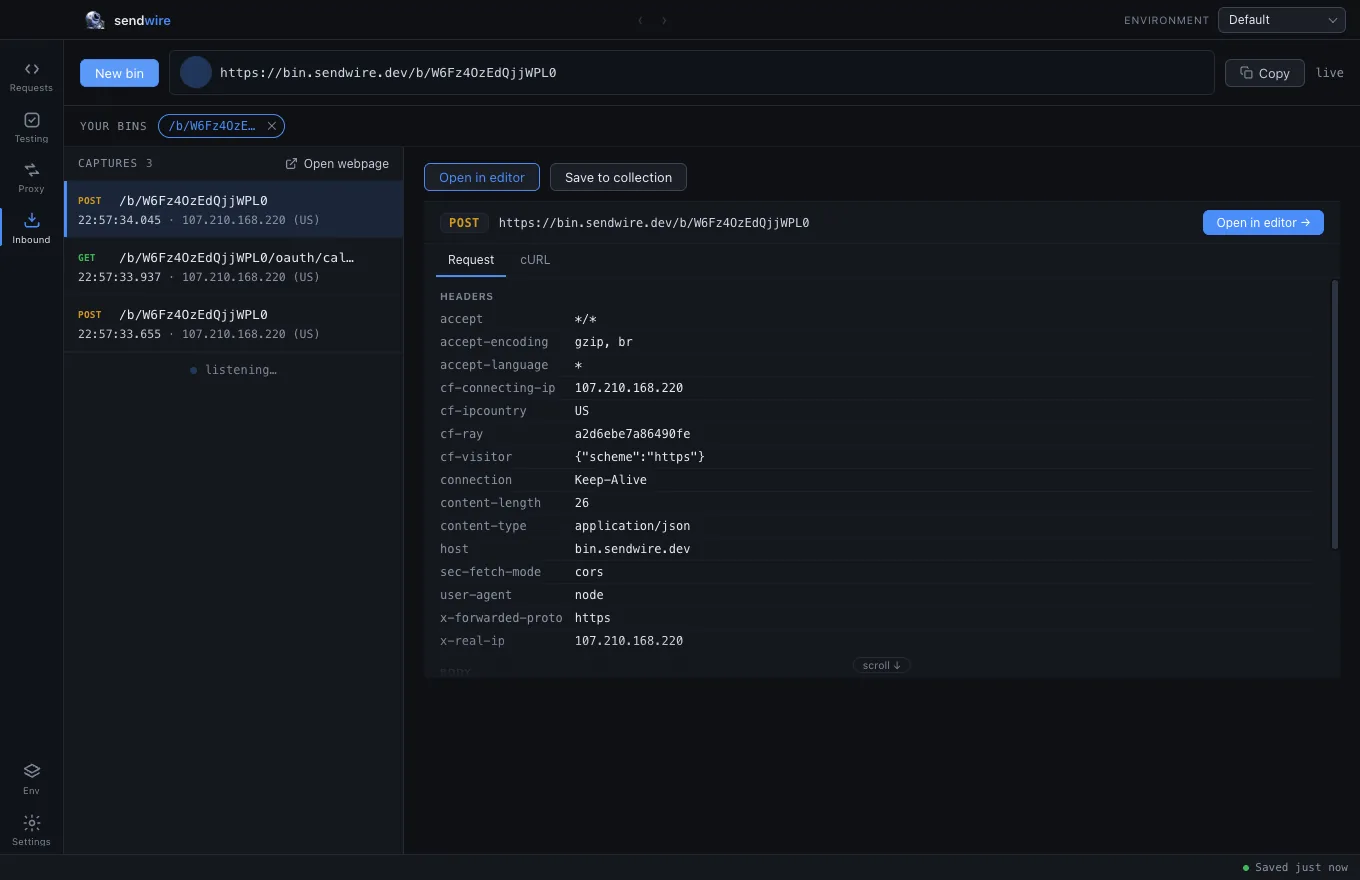
Some requests you don't make — you receive. A webhook from a payment provider, an OAuth redirect, a callback from a service you're wiring up. Inbound gives you a public URL that captures every request sent to it, and streams them in live as they land.
It is the Inbound mode in the left rail — the twin of the capture proxy. Same loop, same click-a-row-into-the-editor move; only the source is a hosted request bin rather than traffic passing through your machine.
Create a bin
Press New bin. Sendwire asks bin.sendwire.dev for a fresh, unguessable URL and shows it in a field you can select or Copy. There is no sign-up — the URL is the whole key: anyone with it can post to it, and anyone without it cannot.
Point a webhook, an OAuth callback, or a curl at that URL. Every request that arrives is captured — method, path, headers, query and body — and appears in the list the moment it lands.
The two panes
| Captures (left) | One row per request, newest first, with its method, path, arrival time and the caller's IP — and country, when the bin knows it. |
| Detail (right) | The selected capture in full: headers, query and body. A body over 64 KB is truncated, and the row says so. |
A listening… heartbeat stays pinned to the list, so it is always clear the bin is connected. Captures stream in over a live socket; if it drops, Sendwire falls back to polling to keep the list fresh, then reconnects on its own.
Turn a capture into a request
Two actions on any capture:
| Open in editor | Loads it into the editor as an ordinary request — replay it, edit it, save it, or generate code from it. |
| Save to collection | Files it straight into a collection. |
A bin always answers 200, so a capture is a request that was received. There is no response to show beside it, the way a proxy capture or a live request has one — Inbound is about what arrived, not what came back.
Managing bins
Bins you've created appear as chips under Your bins; click one to switch to it.
| Forget (✕ on a chip) | Removes the bin from this list. It is not deleted on the server. |
| Discard (✕ on a capture) | Deletes that capture for good — on the bin too, so a reconnect won't bring it back. |
| Open webpage | Opens the same captures on bin.sendwire.dev in your browser. |
Expiry
A bin auto-expires after 7 days of inactivity. When one has expired, Sendwire says so and offers a fresh one rather than leaving a dead spinner.
It is optional
Inbound is the one part of Sendwire that talks to a Sendwire-hosted service, and it is entirely opt-in — nothing happens until you create a bin. If bin.sendwire.dev is unreachable the rest of the app is unaffected. Captured requests are input from anyone who has the URL, so Sendwire renders them as plain text, never as markup. See Privacy and data for what this sends.