
Appearance
Code generation
A single request
Code snippet turns the request on screen into runnable code, in thirteen languages: cURL, HTTP, JavaScript, Python, Go, C#, Java, Ruby, Rust, PHP, PowerShell, Dart, and a Claude prompt.
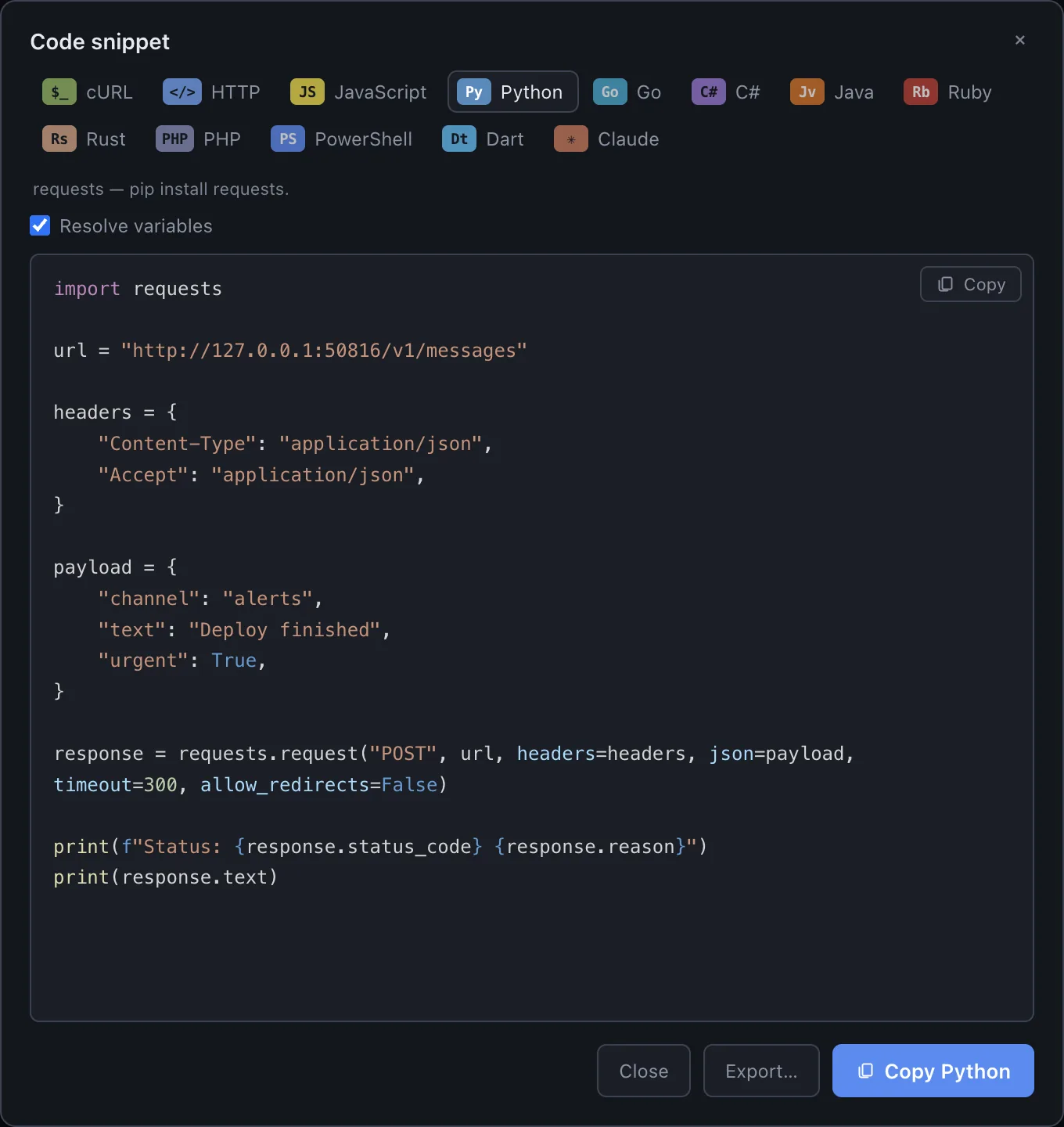
It is generated from the same request the engine sends — so what you copy is the request you just watched work, not a reconstruction of it. That includes the headers the client adds, which is usually what is missing when a snippet does not reproduce a result.
Resolve variables substitutes {{name}} for real values. Leave it off to keep the placeholders — and note the warning that appears when a resolved snippet contains secrets, before you paste it into a chat window.
A whole suite
Export as script produces a standalone Node file. No Sendwire, no dependencies beyond Node itself.
Your scripts are carried across verbatim. The exported file ships a small sw shim implementing the same API, and your pre-request and post-response code runs unchanged inside it.
That is worth being precise about, because the alternative is worse. An earlier version tried to translate scripts into declarative steps, and anything it could not express — an HMAC signature, a loop, a conditional — silently became a TODO comment and a dropped header. Running the same JavaScript means there is nothing to fail to express.
sh
node checkout-flow.mjsIt exits non-zero when an assertion fails, shares cookies across steps, and prints results in the same shape as the command line — so it drops into CI as it is.
Share an exchange
Sometimes the thing to hand over isn't code — it's the evidence. Share → Export writes a single, self-contained HTML file of one request and its response: the exact bytes sent, the timings, the full certificate chain, the body, and a runnable cURL. Nothing external is referenced, so it opens offline and reads the same six months from now — made to email to an API's vendor when "it's returning 500" needs proof.
The page carries an Open in Sendwire deep link that reopens the request in the app, and the export offers to mask secrets before it is written, so an Authorization header doesn't ride along by accident.